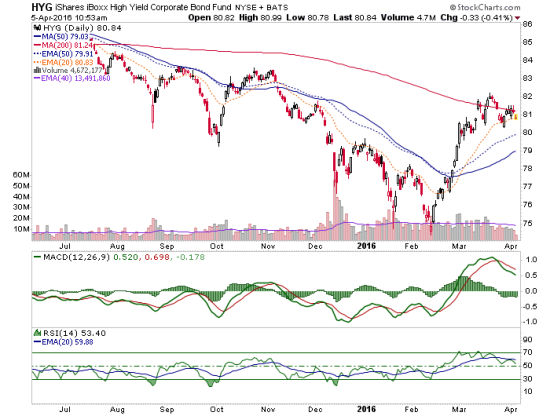
Les emprunts à haut risk ont fait un beau parcours sur les interventions des Banques Centrales depuis la mi fevrier.
Le graphique ci dessous est cependant sinistre dans la mesure ou on ne parvient pas à dépasser la moyenne mobile des 200. Cela fait trois tentatives infructueuses. On est en train de fabriquer une sorte de tête et épaules avec l’épaule droite bien en dessous de la première, l’épaule gauche.
Le fait que les corrélations avec le dollar/yen soient catastrophiques n’arrange rien. On sait que la meilleure corrélation du risk-on/risk-off est avec la parité du dollar/yen. Quand le yen baisse contre le dollar les marchés montent, quand il monte, ils se mettent en risk-off.
De Kimble Charting Solutions
The US$/Yen has been correlated with stocks fairly well over the past few years. As the US$/YEN was hitting highs over the past year, stocks followed right along with it.
Potential is in play, that the US$/YEN has created a “head & shoulders” topping pattern. If this read happens to be true and it breaks support and turns weak at (1), it would be sending a risk off message to the stock market.
What the US$/Yen does in the next couple of weeks at (1), should be VERY important for stocks going forward. Stock bulls want/need to see the US$/YEN to push higher.
Les fondamentales du HYG sont mauvaises , bien au dela des secteurs pétroliers et matières premières. Une récente étude de la BofA montre que l’on s’achemine vers des défauts records, les EBITDA sont largement insuffisants dans une large sélection de secteurs. Le ralentissement en cours -qui se précise- ne va rien arranger.
Michael Contopoulos de la BofA pense que l’on n’échappe pas aux fondamentales et elles ne cessent de se détériorer.
We’ve written on multiple occasions how the main question mark surrounding the end of this credit cycle is its shape, not whether we’re currently living through it. As mentioned above, fundamentals have been consistently deteriorating even outside of commodities, defaults are rising, new credit creation is becoming difficult, and illiquidity is still a problem. Although technical tailwinds in the form of retail inflows and supportive central bank policies can prolong the market unwind, they do not change its direction as ultimately fundamentals will prevail.
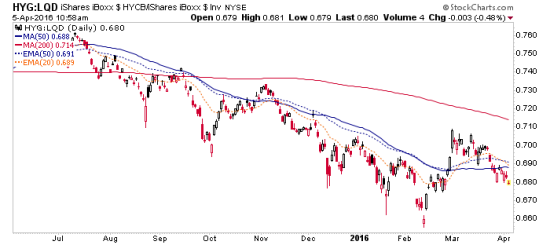
Le comportement relatif du HYG en regard de l’investment grade est négatif. Regardez le graphique comparé.
 brunobertez