Davos est un microcosme; c’est le condensé, le monde en réduction. C’est le spectacle concentré de l’ordre mondial, celui que nous appelons le (des)ordre.
Ne vous y trompez pas, nous stigmatisons Davos et l’élite non par tendance ou préoccupation égalitariste, vous nous lisez régulièrement et vous savez que nous sommes pour un monde inégalitaire sous la condition que ces inégalités reflètent une utilité sociale, présente ou passée. Ce n’est plus le cas dans nos société à cause du détournement du bien commun, la monnaie et le crédit qui servent à enrichir les kleptocrates; les kleptocrates, ce sont ceux qui confisquent le bien commun.
Les gains colossaux de certains, innovateurs, footballeurs, artistes, etc ne nous gênent absolument pas car dans nos systèmes, les gagnants empochent certes toutes les mises, mais si ils ont apporté quelque chose, personne n’est en mesure de dire ce que cela vaut , hormis le marché, et si le marché permet que les gagnants empochent toutes les mises , alors pourquoi pas? C’est toujours mieux que si une Nomenklatura comme celle qui est réunie à Davos décide qui doit gagner et combien.
Le marché est dur, mais c’est le prix à payer pour la liberté et à condition qu’en contrepartie les responsabilités soient assumées par ceux qui en bénéficient. Or ce n’est plus le cas dans le système klepto: « ils » cassent et nous payons. Exemple, Lagarde , elle nous a couté 400 millions d’euros, mais elle n’est pas responsable, ou plutôt elle est coupable mais dispensée de peine, de punition, de sanction et elle parade à Davos au lieu d’être virée du FMI.
Le problème central de nos systèmes, c’est le (des)ordre Crony, c’est à dire le fait que participant au pouvoir, ou en étant proches, ils ne sont pas sanctionnés. Le problème central c’est la collusion organique entre la finance et le politique, par le biais de la sociale démocratie . « Ils » ont tout cassé en 2008 et c’est vous qui payez tandis qu’ils ‘enrichissent encore plus grâce à l’argent gratuit, aux taux zéro, aux QE et aux assurances qu' »on » leur donne.
A Davos il y a 3000 personnes , politiciens, business leaders, économistes, chefs d’entreprises, célébrités du show biz et du charity business. La plupart voyagent en jets privés comme le maire de Londres Sadiq Khan lequel est ensuite acheminé en hélicoptère. On attend tellement de jets que le gouvernement suisse a ouvert l’aéroport militaire de Dubendorf. Chaque jet brule en une heure plus de carburant qu’une voiture en un an, mais on parlera beaucoup du réchauffement climatique. Le WEF considère que c’est une priorité.
EN PRIME
At Davos’ super luxury hotel the Belvedere, there will be “specially recruited people just for mixing cocktails”, as well as baristas, cooks, waiters, doormen, chambermaids and receptionists to host world leaders, business people and celebrities, who this year include pop star Shakira and celebrity chef Jamie Oliver (worth $400m).
Last year, a Silicon Valley tech company was reportedly charged £6,000 for a short meeting with the president of Estonia in a converted luggage room. The hotel has also previously flown in New England lobster and provided special Mexican food for a company that was meeting a Mexican politician.
Last year, former UK PM David Cameron partied tie-less with Bono, Leonardo DiCaprio and Kevin Spacey, at a lavish party hosted by Jack Ma, the founder of internet group Alibaba and China’s richest man with a $34.5bn (£28.5bn) fortune. Tony Blair also attended the Ma party last year.
Basic membership of the WEF and an entry ticket costs 68,000 Swiss francs (£55,400).
To get access to all areas, corporations must pay to become Strategic Partners of the WEF, costing SFr600,000, which allows a CEO to bring up to four colleagues, or flunkies, along with them. They must still pay SFr18,000 each for tickets.
Just 100 companies are able to become Strategic Partners; among them this year are Barclays, BT, BP, Facebook, Google and HSBC.
The most exclusive invite in town is to an uber-glamorous party thrown jointly by Russian billionaire Oleg Deripaska and British financier Nat Rothschild at the oligarch’s palatial chalet, a 15-minute chauffeur-driven car ride up the mountain from Davos.
In previous years, Swiss police have reportedly been called to Deripaska’s home after complaints about the noise of his Cossack band. Deripaska’s parties have “endless streams of the finest champagne, vodka, and Russian caviar amidst dancing Cossacks and beautiful Russian models. »
The official theme of this year’s forum is “responsive and responsible leadership”!
That hints at the concerns of global’s elite: they need to be ‘responsive’ to the popular reaction to globalisation and the failure of the system to deliver prosperity since the end of the Great Recession and they also need to be ‘responsible’ in their policies and actions, a subtle appeal to the newly inaugurated Donald Trump as US president
The WEF has been the standard bearer of the positives from ‘globalisation’, new technology, free markets, ‘Western democracy’ and ‘responsible’ leadership. Trump and other leaders of global and regional powers now seem to threaten that enterprise.
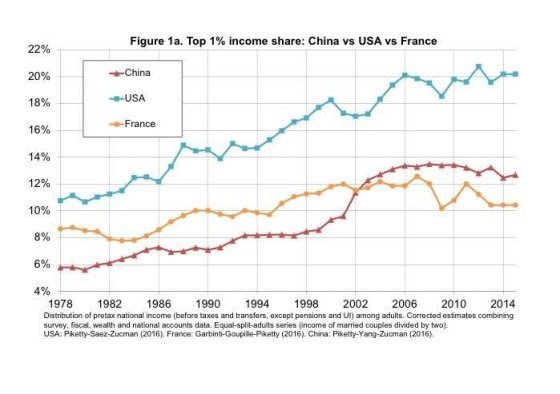
While, globally, inequality between countries has been « decreasing at an accelerating pace over the past 30 years », within countries, since the 1980s the share of income going to the top 1% has increased in the United States, United Kingdom, Canada, Ireland and Australia (although not in Germany, Japan, France, Sweden, Denmark or the Netherlands).
And as the WEF says, the slow pace of economic recovery since 2008 has « intensified local income disparities with a more dramatic impact on many households than aggregate national income data would suggest. »
- Key facts about Davos 2017January 10, 2017 16:37

As the past year has demonstrated, leaders must be responsive to the demands of the people who have entrusted them to lead, while also providing a vision and a way forward, so that people can imagine a better future.
True leadership in a complex, uncertain, and anxious world requires leaders to navigate with both a radar system and a compass. They must be receptive to signals that are constantly arriving from an ever-changing landscape, and they should be willing to make necessary adjustments; but they must never deviate from their true north, which is to say, a strong vision based on authentic values.
That is why the World Economic Forum has made Responsive and Responsible Leadership the theme for our annual January meeting in Davos. As leaders in government, business, and civil society chart a course for the next year, five key challenges will warrant their attention.
Firstly, they will have to come to grips with the Fourth Industrial Revolution, which is redefining entire industries, and creating new ones from scratch, owing to groundbreaking advances in artificial intelligence, robotics, the Internet of Things, self-driving vehicles, 3D-printing, nanotechnology, biotechnology, and quantum computing.
These technologies have only begun to show their full potential; in 2017, we will increasingly see what used to be science fiction become reality. But, while the Fourth Industrial Revolution could help us solve some of our most pressing problems, it is also dividing societies into those who embrace change and those who do not. And that threatens our wellbeing in ways that will have to be identified and addressed.
Secondly, leaders will have to build a dynamic, inclusive multi-stakeholder global-governance system. Todays’s economic, technological, environmental, and social challenges can be addressed only through global public-private collaboration; but our current framework for international cooperation was designed for the post-war era, when nation-states were the key actors.
At the same time, geopolitical shifts have made today’s world truly multipolar. As new global players bring new ideas about how to shape national systems and the international order, the existing order is becoming more fragile. So long as countries interact on the basis of shared interests, rather than shared values, the extent to which they will be able to cooperate will be limited. Moreover, non-state actors are now capable of disrupting national and global systems, not least through cyber attacks. To withstand this threat, countries cannot simply close themselves off. The only way forward is to make sure that globalization is benefiting everyone.
A third challenge for leaders will be to restore global economic growth. Permanently diminished growth translates into permanently lower living standards: with 5% annual growth, it takes just 14 years to double a country’s GDP; with 3% growth, it takes 24 years. If our current stagnation persists, our children and grandchildren might be worse off than their predecessors.
Even without today’s technologically driven structural unemployment, the global economy would have to create billions of jobs to accommodate a growing population, which is forecast to reach 9.7 billion by 2050, from 7.4 billion today. Thus, 2017 will be a year in which social inclusion and youth unemployment become critical global and national issues.
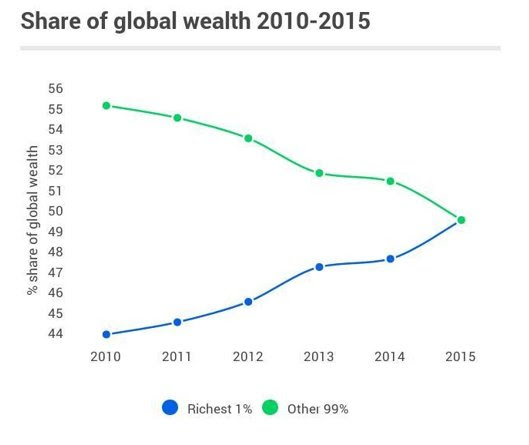
A fourth challenge will be to reform market capitalism, and to restore the compact between business and society. Free markets and globalization have improved living standards and lifted people out of poverty for decades. But their structural flaws – myopic short-termism, increasing wealth inequality, and cronyism – have fueled the political backlash of recent years, in turn highlighting the need to create permanent structures for balancing economic incentives with social wellbeing.
Finally, leaders will need to address the pervasive crisis in identity formation that has resulted from the erosion of traditional norms over the past two decades. Globalization has made the world smaller but more complex, and many people have lost confidence in institutions. Many people now fear for their future, and they are searching for shared but distinct beliefs that can furnish a sense of purpose and continuity.
Identity formation is not a rational process; it is deeply emotional and often characterized by high levels of anxiety, dissatisfaction, and anger. Politics is also driven by emotion: leaders attract votes not by addressing needs or presenting long-term visions, but rather by offering a sense of belonging, nostalgia for simpler times, or a return to national roots. We witnessed this in 2016, as populists made gains by fostering reactionary and extreme beliefs. Responsible leaders, for their part, must recognize people’s fears and anger as legitimate, while providing inspiration and constructive plans for building a better future.
But how? The world today seems to be engulfed in a sea of pessimism, negativity, and cynicism. And yet, we have an opportunity to lift millions more people out of poverty, so that they can lead healthier and more meaningful lives. And we have a duty to work together toward a greener, more inclusive, and peaceful world. Whether we succeed will not depend on some external event, but rather on the choices our leaders make.
The coming year will be a critical test for all stakeholders in global society. More than ever, we will need responsive and responsible leadership to address our collective challenges, and to restore people’s trust in institutions and in one another. We do not lack the means to make the world a better place. But to do so, we must look past our own narrow interests and attend to the interests of our global society.
That duty begins with our leaders, who must begin to engage in open dialogue and a common search for solutions to the five major challenges on the horizon. If they acknowledge that ours is a global community with a shared destiny, they will have made a first – albeit modest – step in the right direction.
Quelques graphiques

 brunobertez