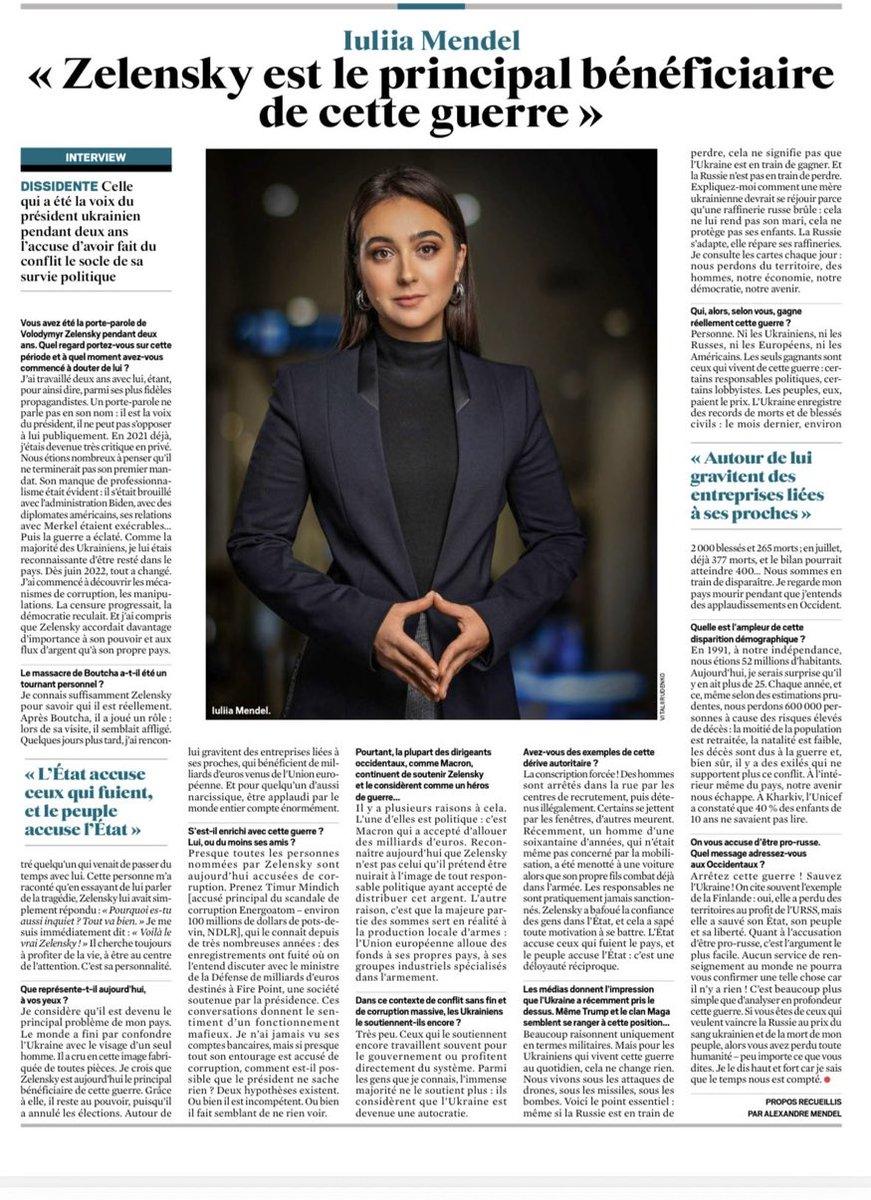
Traduction en anglais de l’interview d’Iuliia MendelIuliia Mendel
« Zelensky is the main beneficiary of this war »
INTERVIEW
DISSIDENT
She was the voice of the Ukrainian president for two years. Today she accuses him of having made the conflict the foundation of his political survival.
You were Volodymyr Zelensky’s spokesperson for two years. What assessment do you make of that period and when did you start to doubt him?
I worked with him for two years and, so to speak, I was among his most loyal propagandists. A spokesperson does not speak in their own name: they are the president’s voice. In public, one cannot oppose him. In 2021 I had already become more critical in private. Many of us thought that he would not finish his first term. His lack of professionalism was obvious: he had fallen out with the Biden administration, with American diplomats, his relations with Merkel were terrible… Then the war broke out. Like the majority of Ukrainians, I was grateful to be still in the country. From June 2022 onwards, everything changed. I began to discover the mechanisms of corruption and the manipulations. Censorship was progressing, democracy was receding. And I realised that Zelensky was giving more and more importance to his power and to the flows of money than to his own country.Was the Bucha massacre a personal turning point for you?
I know Zelensky well enough to know that he is genuinely affected. After Bucha he played a role: during his visit he seemed distressed. A few days later I met him again…« The state accuses those who flee, and the people accuse the state »… and I felt that something had changed in him. Someone close to him told me, while trying to talk to him about the tragedy, that Zelensky simply replied: “Why are you worried too? Everything is fine.” I immediately thought: “There is the real Zelensky.” He is always looking to take advantage of life, to be at the centre of attention. That is his personality.Who does he represent today, in your eyes?
I believe he has become the main problem of my country. The world has ended up confusing Ukraine with the face of a single man. He has created this image of himself, fabricated from every angle. I believe that today Zelensky is the main beneficiary of this war. Thanks to it, he remains in power, since he cancelled the elections. Around him gravitate companies linked to his relatives, who benefit from the billions of euros coming from the European Union. And for someone with a narcissistic ego, being applauded by the whole world counts enormously.Has he enriched himself from this war?
Him, or at least his friends? Almost all the people appointed by Zelensky are today accused of corruption. Take Timur Mindich [accused in the Energoatom corruption scandal – about 100 million dollars of kickbacks, NDLR], who has known him for many years: recordings exist. One hears them discussing with the Defence Minister billions of euros destined for Fire Point, a company close to the presidency. These conversations give the feeling of a mafia organisation. I have never seen bank receipts, but if almost his entire entourage is accused of corruption, how is it possible that the boss knows nothing? Two hypotheses remain. Either he is incompetent. Or he pretends to see nothing.Yet the majority of Western leaders, starting with Macron, continue to support Zelensky and regard him as a war hero…
There are several reasons for that. One of them is political: it is Macron who agreed to unlock billions of euros. Recognising today that Zelensky is not the man he claims to be would damage the image of any political official who has helped distribute that money. The other reason is that a large part of the sums are in reality directed towards local arms production: the European Union allocates funds to its own companies, to its industrial groups specialised in armaments.In this context of endless conflict and massive corruption, do Ukrainians still support him?
Very few. Those who still support him often work for the government or profit directly from the system. Among the people I know, the vast majority no longer support him. They consider that Ukraine has become an autocracy.Do you have examples of this authoritarian drift?
Forced conscription! Men are arrested in the street by recruitment centres, sometimes detained illegally. Some are thrown out of windows, others die. Recently, a man of military age, a disabled person who was not even concerned by mobilisation, was run over by a car while his own son was already fighting in the army. Those responsible have practically never been sanctioned. Zelensky has shattered the confidence of people in the state, and that has undermined all motivation to defend the country. The state accuses those who flee the country, and the people accuse the state: it is a reciprocal disillusionment.The media give the impression that Ukraine has recently taken the upper hand. Even Trump and the Maga camp seem to be aligning with this position…
Many people reason only in military terms. But for the Ukrainians who are living through this war on a daily basis, nothing has changed. We still suffer drone attacks, missile attacks, bombs. Here is the essential point: even if Russia is in the process of losing, that does not mean that Ukraine is in the process of winning. And Russia is not about to lose. Explain to me how a Ukrainian mother should rejoice because a Russian oil refinery is burning: that does not give her back her husband, that does not protect her children. Russia adapts, it repairs its refineries. I insult the cards every day: we are losing our territory, our men, our economy, our democracy, our future.Who, in your view, is really winning this war?
No one. Neither the Ukrainians, nor the Russians, nor the Europeans, nor the Americans. The only real winners are those who live off this war: certain political officials, certain lobbyists. The peoples, for their part, are paying the price. Ukraine is recording records of dead and wounded civilians: last month, around 2,000 wounded and 265 dead; in July, already 377 dead, and the toll could reach 400. We are in the process of disappearing. I look at my husband while I hear the applause in the West.« Around him gravitate companies linked to his relatives »What is the scale of this demographic disappearance?
In 1991, at independence, we were 52 million inhabitants. Today, I would be surprised if we still numbered 25 million. Every year, and this is according to the most prudent estimates, we lose 600,000 people because of the high death rates, the migration of the population that has left, the low birth rate, the deaths linked to the war and, of course, the exiles who will never return to the country – our future is escaping us. In Kharkiv, Unicef has established that 40 % of children aged 10 no longer knew how to read.You are accused of being pro-Russian. What message do you address to Westerners?
Stop this war! Save Ukraine! People often cite the example of Finland: yes, it lost territories to the profit of the USSR, but it saved its state, its people and its freedom. As for the accusation of being pro-Russian, the argument is too easy. No re-education service will be able to make me confirm such a thing, because there is nothing to it! There is much more to analyse in depth than “Ukraine against Russia at any cost”. If you are one of those who want to defeat Russia at the price of Ukrainian blood and the death of my people, then you have lost all humanity – whatever you may say. I say it loud and clear because I know that time is running out.PROPOS COLLECTED
BY ALEXANDRE MENDEL
LA BIO DE MENDEL SELON L’IA
Nom complet : Iuliia Volodymyrivna Mendel (ukrainien : Юлія Володимирівна Мендель)
Date et lieu de naissance : 3 septembre 1986 à Henichesk (oblast de Kherson, alors RSS d’Ukraine, URSS).
Elle a actuellement 39 ans.
Formation
- Diplômée de l’Université nationale Taras Chevtchenko de Kiev.
- Candidate en sciences philologiques (équivalent d’un doctorat).
Carrière journalistique
Elle possède plus de 14 à 18 ans d’expérience en journalisme (télévision et presse écrite). Elle a travaillé pour plusieurs chaînes ukrainiennes (ICTV, Espresso TV, 112 Ukraine, Inter) et a collaboré avec des médias internationaux :
- The New York Times
- The Washington Post
- Politico Europe
- VICE
- The Atlantic Council
- Spiegel Online
- CNBC
- World Affairs Journal
Avant d’entrer dans l’administration présidentielle, elle a également été consultante en communication pour la Banque mondiale en Ukraine.
Porte-parole de Volodymyr Zelensky
- Elle a remporté un concours et a été nommée secrétaire de presse et porte-parole du président Volodymyr Zelensky le 3 juin 2019.
- Elle a occupé ce poste jusqu’au 9 juillet 2021 (environ deux ans).
- À ce titre, elle gérait la communication stratégique de l’administration présidentielle, les relations internationales et l’image du président.
Après 2021
- Elle a quitté ses fonctions plusieurs mois avant l’invasion russe à grande échelle de février 2022.
- En 2022, elle a publié son livre « The Fight of Our Lives: My Time with Zelenskyy, Ukraine’s Battle for Democracy, and What It Means for the World » (Simon & Schuster), un récit de son expérience auprès de Zelensky et des événements précédant la guerre.
- Elle écrit régulièrement des tribunes d’opinion pour The Washington Post.
- Elle a été Distinguished Fellow du Weiser Center for Europe and Eurasia et Knight-Wallace Fellow à l’Université du Michigan (2023-2024).
- Elle intervient régulièrement comme conférencière et commentatrice politique.
Vie personnelleElle est mariée à Pavlo Kukhta (économiste ukrainien, ancien vice-ministre de l’Économie).
Position actuelle
Depuis plusieurs années, Iuliia Mendel est devenue une voix critique à l’égard de Volodymyr Zelensky.
Elle l’accuse notamment d’avoir fait de la guerre le fondement de sa survie politique, de tolérer la corruption et de glisser vers l’autoritarisme.
Ces positions lui valent d’être régulièrement accusée (par des médias ukrainiens et pro-gouvernementaux) de reprendre des narratifs pro-russes, ce qu’elle rejette fermement.
Elle se présente aujourd’hui comme une journaliste indépendante et une « dissidente » qui continue de commenter la situation en Ukraine.
 brunobertez