Si vous êtes économiste et que vous voulez un job il faut que vous soyez conformes. Vous devez professer les mêmes mensonges à longueur de journée, au travail, dans la presse en amphithêatre si vous êtes enseignant. Un économiste est complice, connivent par construction: il a été formaté et il a compris qu’en dehors de ce formatage, il n’y a pas de salut.
Michael Hudson n’en a que plus de mérite a essayer de décrire la situation telle qu’elle est malgré son statut académique.
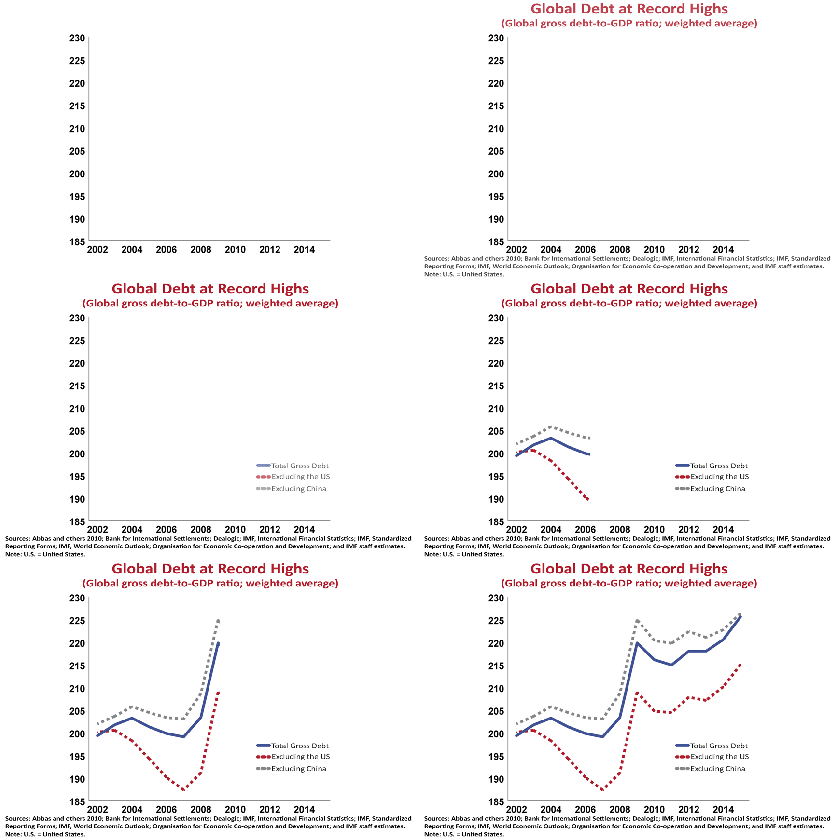
Voici l’essentiel :
-Nous ne sommes jamais sorti de la crise de 2008
-Nous ne sommes plus dans des cycles normaux avec expansion et ralentissement, nous sommes dans une sorte de longue dépression qui ne dit pas son nom.
-Nous ne sommes ni en reprise ni en récession
-La cause en est qu’à chaque reprise économique passée nous sommes reparti avec un niveau de dettes plus élevé
-Le niveau de dettes est si élevé que nous sommes en déflation par la dette, en debt-deflation
-Les gens doivent tellement à la banque qu’ils ne peuvent acheter les biens qu’ils produisent, il n’y a pas d’investissements productifs, il n’y a pas de nouveaux emplois qui paient bien, il n’y a que des petits boulots au salaire minimum, les débouchés rétrécissent
-Les banques ne seront jamais remboursées, il n’y aura jamais assez d’agent pour cela, donc elles sont insolvables et ce n’est pas à cause des déficiences du système financier, c’est parce qu’il y a trop de dettes que l’on ne pourra jamais honorer
-L’idée de nos systèmes que l’on peut devenir prospère en s’endettant est une idée fausse, cela ne marche pas
-La dette globale dit le FMI est de 152 trillions (note de BB, elle est bien supérieure à cela en réalité) , pour la rembourser il faudrait baisser les niveaux de vie, massacrer les pensions, les assurances santé , les protections sociales, vendre les patrimoines des états; si on va dans cette direction, c’est le nouveau féodalisme, l’esclavage par la dette, les gens deviendront debt-slaves. C’est une régression d’un millénaire.
-Nous sommes à la fin d’un cycle qui a débuté en 1945; nous avons accumulé trop de dettes et le seul moyen de s’en sortir est d’effacer les dettes, de les restructurer comme le FMI voulait le faire pour la Grèce, mais le FMI n’a pas le courage de le dire publiquement
-Si vous ne le faites pas, la seule fonction qui restera aux gouvernements sera de taxer, « presser le citron », d’extraire assez de ressources de l’économie pour honorer les dettes dues aux banques et aux marchés et ce sera la régression, la population devra baisser , un terrible enchainement
-pour l’insant la politique de tous les gouvernements sans exception est de sauver les banques, pas de sauver les économies et les citoyens
-Dans cette voie, c’est un cercle vicieux, plus vous ponctionnez pour sauver les banques et plus l’économie se contracte, il n’y a pas d’issue, et un jour ce sera la fin des illusions
« But ultimately it can’t be saved, because of the mathematics that are involved. Debts grow and grow. And the more they grow, the more they shrink the economy. When you shrink the economy, you shrink the ability to pay the debts, so it’s all an illusion that the system can be saved. The question is, how long are people going to be willing to live in this illusion? »
KIM BROWN, TRNN: Joining us from New York is Michael Hudson. Michael is a Distinguished Research Professor of Economics at the University of Missouri, Kansas City. His latest book is Killing the Host: How Financial Parasites and Debt Bondage Destroy the Global Economy. Michael, thanks again for joining us.
MICHAEL HUDSON: Its good to be here. But we can’t get out of the woods.
BROWN: Okay, let’s get into that. The IMF report on financial stability says, in spite of banks being stronger now than before the economic crisis of 2007-2008, about twenty-five percent of US banks and about a third of European banks are too weak to even benefit from a potential rise in interest rates and any recovery aid, should the global economy take a downward turn. But before we get into any specific questions about the health of banks, Michael, are we still in a recession or are we firmly in a recovery now?
HUDSON: We are not in a recovery and we’re not really in a traditional recession. People think of a business cycle as a boom followed by a recession and then automatic stabilizers revive the economy. But this time we can’t revive. The reason is that every recovery since 1945 has begun with a higher, and higher level of debt. The debt is so high now, that since 2008 we’ve been in what I call, debt deflation. People have to pay so much money to the banks that they don’t have enough money to buy the goods and services they produce. So there’s not much new investment, there’s not new employment (except minimum-wage “service” jobs), markets are shrinking, and people are defaulting. So many companies can’t pay their banks.
It was a false model. So really, we’re at the end of long cycle that began in 1945, loading the economy with debt. We’re not going to be able to get out of it until you write down the debts. But that’s what the IMF believes is unthinkable. It can’t say that, because it’s supposed to represent the interest of the banks. So all the IMF can say is to wring their hands over the fact that the banks won’t make money even if there is a recovery.
But there really isn’t a recovery, and no signs of it on the horizon, because people have to pay the banks. It’s a vicious circle – or rather, a downward spiral. Basically, the IMF economists are just throwing up their hands and admitting that they don’t know what to do, given the limits of their tunnel vision.
BROWN: Well, Michael, help us figure out why growth has been so weak over these past eight to six years or so.
HUDSON: If you take the average family budget – and I’ve said this on your show many times –we can go through the numbers. If you have to pay about forty to forty-three percent of your income for housing, you also have to pay fifteen percent of your paycheck for the FICA for Social Security wage withholding. You have to pay medical care, you have to pay the banks for your credit card debt, student loans. Then you only have about twenty-five or thirty-five percent, maybe one-third of your salary to buy goods and services. That’s all.
The problem here is that the way you get a job is with a company that sells goods and services. The companies aren’t hiring, because consumers don’t have enough money to buy the goods and services.
We’re in a chronic debt-deflation. There’s no way we can recover unless you write down the debts. And that’s what the IMF basically is implying (and it was explicit regarding Greece), but its not spelling it out, because that’s not what can be said in polite company.
BROWN: Michael the headline from MarketWatch about this IMF report, it reads, “Forget too big to fail. The big concern is banks too weak to survive.” If big banks almost capsized the global financial system, are weaker banks actually better for consumers?
HUDSON: Banks that are very narrow and do what banks used to do (before President Clinton abolished Glass-Steagall in 1999). Small banks that lend to consumers are fine. Most banks – with Deutsche Bank at the top of the spectrum here – have decided that they can’t make money lending to barrowers anymore, so they’re going to the second business plan: They lend money to casino capitalists. That is, to people who want to gamble on derivatives.
A derivative is a bet on whether a stock, or a bond or a real estate asset, is going to go up or down. There’s a winner and a loser. It’s like betting on a horserace. So the biggest bank lending for gambles – not for real production, not for investment, but just for gambles – was Deutsche Bank. Borrowers borrowed from Deutsche Bank to gamble.
What’s the best gamble in the world, right now? Its betting that Deutsche Bank stock is going to go down. Short sellers borrowed money from their banks to place bets that Deutsche Bank stock is going to go down. Now, it’s wringing its hands and saying, “Oh the speculators are killing us.” But it’s Deutsche Bank and the other banks that are providing the money to the speculators to bet on credit.
BROWN: Michael, the IMF report says that in the Eurozone, if the Eurozone governments could help banks dump their bad loans, it would have a positive effect on bank capital. What would be the effect on consumers in the EU economy, at large, if banks were able to just dump these bad loans?
HUDSON: Its really very simple mathematics. You have to abolish pension plans. You have to abolish social spending. You have to raise taxes. You have to have at least fifty percent of the European population emigrate, either to Russia or China. You would have to have mass starvation. Very simple. That’s the price that the Eurozone thinks is well worth paying. It’s the price that it thought Greece is worth paying. To save the banks, you would have to turn the entire Eurozone into Greece.
You’ll have to have the governments sell off all of their public domains; sell off their railroads, sell off their public land. You’ll essentially have to introduce neo-feudalism. You’ll have to roll the clock of history back a thousand years, and reduce the European population to debt slavery. It’s as simple a solution as the Eurozone has imposed on Greece. And it’s a solution that the leaders and the banks are urging for responsible economists to promote for the population at large.
BROWN: Let’s talk about the other little nugget of information released by the IMF about debt. Global debt has now reached about a hundred and fifty-two trillion dollars. This includes government debt, household debt, non-financial firms’ debt. What does all this debt mean for the global financial system and for everyday people here, Michael?
HUDSON: It means that the only way people can repay the debt is by cutting their living standards very drastically. It means agreeing to shift their pension plans from defined benefit plans – when you know what you’re going to get – into just “defined contribution plans,” where you put money in, like into a roach motel, and you don’t know what’s coming out.
To save the banks from making losses that would wipe out their net worth, you’ll have to get rid of Social Security. It means that you’ll essentially have to abolish government and turn it over to the banking system to run, with an idea that the role of governments is to extract income from the economy to pay to the bondholders and the banks.
When you say “paying the banks,” what they really mean is paying the bank bondholders. They are basically the One Percent. What you’re really seeing right now in the IMF report, in this growth of debt, is the One Percent of the population owns maybe three-quarters of all this debt. This means that there’s a choice: Either you can save the economy, or you can save the One Percent from losing a single penny.
Every government, from the Obama administration right through to Angela Merkel, the Eurozone and the IMF, promise to save the banks, not the economy. No price is too high to pay to try to make the financial system go on a little bit longer. But ultimately it can’t be saved, because of the mathematics that are involved. Debts grow and grow. And the more they grow, the more they shrink the economy. When you shrink the economy, you shrink the ability to pay the debts, so it’s all an illusion that the system can be saved. The question is, how long are people going to be willing to live in this illusion?
BROWN: That was my next question for you. Not only how long are people going to be able to live in this illusion, but how much longer is this illusion actually sustainable before we see another collapse of economies around the world? Is this something that is impending, that we should just be expecting to come, we should be readying ourselves for this?
HUDSON: We’re still in the collapse that began after 2008. There’s not a new collapse, there hasn’t been a recovery. Wages for the ninety-nine percent have gone down, steadily, since 2008. They’ve gone down especially for the bottom twenty-five percent of the population. This means that they’ve gone down especially for Blacks and Hispanics and other blue-collar workers. Their net worth has actually turned negative, and they don’t have enough money to get by.
In fact, one of the big consulting firms just did a study of the millennials. Ernst and Young did a study and they found seventy-eight percent of millennials are worried about not having enough good paying job opportunity to pay off their student loans. Seventy-four percent can’t pay the health care if they get sick. Seventy-nine percent don’t have enough money to live when they retire. So, already, we’re having a whole generation that’s coming on, not only here but also in Europe, that isn’t able to get good-paying jobs. The only way it can live the life they were promised is if they have rich enough parents who have given them a trust fund.
 brunobertez