BRUNO BERTEZ
3 Juillet
Understanding the dynamics of financialized capitalism.
Global stock market capitalization has reached $166 trillion.
This figure has once again led me to reflect on the inflation of fictitious capital and the vicious circle of overaccumulation.
In June 2026, global stock market capitalization reached a historic record of $166 trillion, according to Bloomberg data.
This represents an increase of +$32 trillion (+23.6%) in just one year, and +$94 trillion (+131%) since the pandemic low in 2020.Over the past twenty years, global stock market capitalization has grown at a compound annual rate of approximately 7%.
Yet global economic growth is significantly weaker.
This divergence has intensified after 2008 and especially after 2020.Relative to global GDP, it is approaching 134%, a level unprecedented over the long term.
The American “market cap / GDP” ratio (often called the Buffett Indicator in its U.S. version) is today at historically high levels. This means that the value of listed companies represents an ever-increasing share of the wealth produced annually.
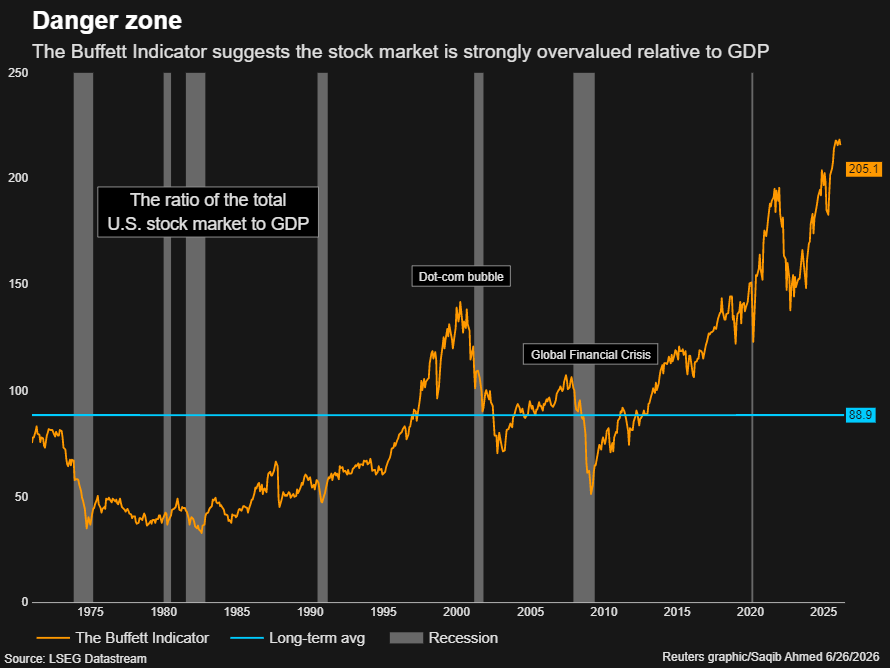
These impressive figures raise a fundamental question: is this inflation of the markets the reflection of a productive economy in full health, or the symptom of a system in which financial capital has largely become autonomous and must constantly seek new sources of “profitability”?
The origin of this stock market inflation lies in the realms of money and debt.
Our modern currencies are essentially created by credit: when a bank grants a loan, it simultaneously creates a deposit. Debt (public and private) is therefore at the heart of the monetary system.After the 2008 crisis and during the pandemic, central banks injected trillions of dollars through Quantitative Easing.
These liquidities were not all absorbed by productive investment.
A large part flowed into financial markets, driving up valuations without necessarily corresponding to an equivalent increase in real production.This is precisely what Marx called fictitious capital: securities (stocks, bonds, derivatives) that represent claims on future surpluses, and not physical capital already engaged in production.
These securities circulate as capital and can valorize autonomously, sometimes — and now increasingly — in a speculative manner.
The more the mass of capital swells, the more the imperative need for profitability is felt.
This is something even Mélenchon in France has understood when he speaks of layoffs or austerity imposed by the Stock Exchange.
The mass of capital creates a need for wage compression, or to put it bluntly, for the superexploitation of workers. In a system where capitals from all over the world are in competition, every fraction of fictitious capital must generate a return. And the more this mass of fictitious capital grows, the greater the need for absolute profit becomes.
To maintain or increase these profits:
- Companies compress wage costs,
- Reduce social benefits,
- Relocate or automate,
- Increase prices (when possible).
This reduces the purchasing power of wage earners, who make up the vast majority of consumers. For production to continue to be absorbed, massive recourse to consumer credit, household debt, and government debt becomes necessary — as the state no longer collects enough taxes.
We thus enter what can be called the vicious circle of overaccumulation:
- Accumulation of fictitious capital creates a need for high profitability
- Wage compression leads to a decline in solvent demand
- Increased recourse to debt to sustain consumption
- New money creation and swelling of financial assets
- Return to point 1… until the next crisis.
It highlights several real mechanisms:
- Global stock market capitalization has indeed reached a record of $166 trillion in June 2026 (according to Bloomberg), with a +23.6% increase in one year and +131% since the 2020 low.
- This is far higher than global GDP growth, which has been around 3-4% per year in nominal terms in recent years.
- The link between monetary inflation, debt creation, and the valuation of financial assets is direct: in the current system, money is predominantly created by bank credit (deposits = debts).
- Post-2008 and post-COVID Quantitative Easing policies massively inflated liquidity, which shifted into assets (stocks, real estate, etc.).
- Marx’s concept of fictitious capital (Capital, Volume III) is entirely applicable: stocks and bonds are not real productive capital, but titles of ownership over future profits — claims on future profits and surplus product.
- The value of fictitious capital is unanchored and autonomous, as it is itself inflated by monetary creation freed since 1971 and 1973.
- The mass of fictitious capital can run away autonomously, as it is doing now under the pressure of the spirit of gambling, creating a financial sphere that detaches itself from the productive economy. As I tirelessly repeat, autonomous finance is the disjunction of shadows and bodies, of signs and the real.
- The considerable mass of stock market capital, of autonomous capital, needs to be made profitable; otherwise the stock market collapses and the entire financial edifice crumbles, taking with it the banking system, insurance, and pensions. This mass therefore mechanically produces a need for profit, a need for valorization. The colossal investment in AI will only aggravate and accelerate everything.
- This is the pressure of the Stock Exchange on the system: the higher the stock market, the more it contains future promises that must be honored, unless one risks financial instability.
- The more colossal the stock market mass, the more profit must be delivered, the more productivity is required, and the less wages. To simplify, firms are forced to lay off, mechanize, modernize, move to AI; to increase capital intensity in order to maintain the profitability not only of the productive capital they have engaged but also the profitability of their stock market capital inflated by speculation and monetary abundance.
- The pressure on wages and purchasing power to maintain profit rates is an observable trend: the share of wages in national income has declined in most developed countries since the 1980s (globalization, automation, weakening of union counter-power).
The purchasing power generated and distributed by true productive economic activity becomes increasingly insufficient and must constantly be supplemented by more credit or redistributions financed by debt.
This creates a structural need for consumer credit and government deficits to absorb production. It reinforces the vicious circle: debt that demands more debt, and ever more debt.Like any vicious circle, it sustains itself and behaves like an Ogre; always demanding more, to the point of devouring its own children like Ugolino.
Finance, once it has taken the upper hand, governs and imposes its law; everything becomes hostage to finance. This was already understood and formulated by Treasury Secretary Geithner in the years following the 2008 revulsion.Everything must be put at its service, because if it revolts, chaos ensues. It always demands more and eats its children — that is, the real productive sphere.
By nature, and endogenously, finance and its stock market space are invasive. In a complex form, it is the simplistic law of accumulation and compound interest at work, with its horizon: the impossible.
The systemic risks of financial overaccumulation and decoupling between finance and the real economy are endogenous to the system that was set in motion in 1971 by the liberation of money, then in the early 1980s by deregulation, by the liberalization of financial and banking assets, and then by submission to the tyranny of the Stock Exchange.
We are in a phase of advanced financialization — an advanced phase, but one that does not proceed in a straight line, which creates the illusion that it can be interrupted.
The system becomes increasingly fragile; in doing so, it demands ever more and dictates an increasingly destructive and iniquitous law. Bourgeois thought detects this in a truncated way by characterizing these moments as so-called Minsky moments (“Minsky moment”).
This does not imply an imminent collapse, because counter-tendencies are at work that delay and postpone the deadlines, as in 2008 and 2020.
However, instability is becoming structural, and it is this instability that produces phases of financial euphoria: every time there is a risk of chaos, the system produces more liquidity, and this liquidity produces euphoria.And the inversion that goes with it:We believe it is because things are going well, when in reality it is because things are going badly!
Today, several signals converge:
- Record levels of global debt (nearly $350 trillion, or more than 300% of global GDP).
- Extreme concentration of stock market gains on a few mega-cap technology companies.
- Growing inequalities between holders of financial assets and wage earners.
The remarkable resilience that is observed is artificial and it has a cost; that cost is:
200 trillion in global liquidity
166 trillion in stock market capitalization
350 trillion in global debt
Fictitious capital, far from being a mere accessory, has become central to the functioning of contemporary capitalism.
It is the crutch that keeps the system standing while continuously undermining it!
A serious debate on financial regulation, capital taxation, the sharing of value added, and the role of money and debt in our societies is more necessary than ever.It will never take place, because those who have the power to decide it are precisely those who would have to commit hara-kiri for the system to survive.
Explore Marx’s concept of fictitious capital
Discuss the Minsky moment theory
Réfléchir plus intensément

