Economic, financial, and monetary crises are not crises in themselves. They are symptoms.The disorder lies deeper: a lasting gap between what is produced and what is promised, followed by a struggle over the distribution of the surplus.
That gap, too, appears in misleading forms.
Whoever sees only the symptom misidentifies the disease, and therefore the remedy.
The principle remains simple. Real wealth—labor, resources, productive capacity—is scarce. The promises that claim to allocate it in advance are not.
The device used by every dominant group, every master, and everyone who profits from the system is always the same: to persuade people that something can be had for nothing, and that promises can be extended without limit.
This is the principle of Paradise.
By promising, they believe they can escape present conflicts over distribution.
It is what Keynes was trying to say while not quite saying it: in the long run we are all dead. Anything can therefore be promised. The only infinity, after all, is human folly.
Debts, currencies, guarantees, social entitlements, and expected returns accumulate faster than the surplus they are supposed to divide.Human nature has not changed. The spirit of speculation lengthens commitments so long as prices rise, and envy forbids staying on the sidelines.
The financial shock is merely the moment when this gap becomes visible, in a break in continuity that reveals the fractal structure beneath, and when each actor tries to exit before the others. It discloses; it does not create.
What has changed is the postmodern capacity to conceal the indicator. Abstraction, complexity, and the imaginary have given elites instruments for deferral into the future that earlier periods did not possess in this form.
Every balance-sheet accident is micromanaged, every contagion is extinguished, every tension is covered by a new promise.
The world of signs thickens, becomes virtual, and takes flight; it pretends to free itself from necessity.
The principle is always to deny that two and two make four—that the magic of growth cancels the law of scarcity, finitude, and gravity.Those necessities have not diminished. They arrive later, in less legible forms.
The absence of an open crash does not prove that the gap has closed. It proves that the “tools of containment” have become more effective, and that private agents have learned to use them: more leverage, shorter financing, liquidity that exists only so long as intervention continues.
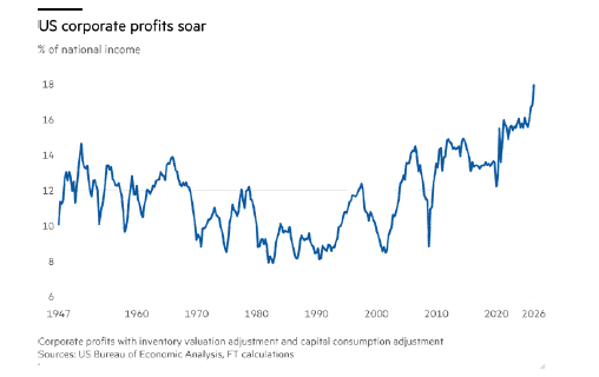
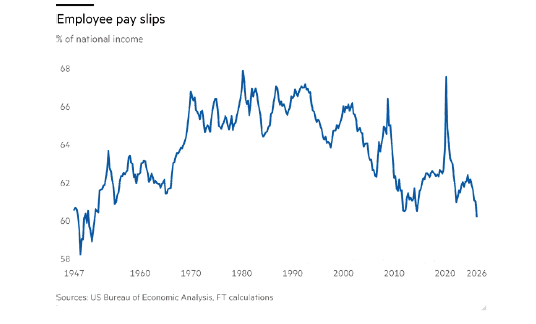
But the contested surplus is not negotiated only in the markets.It is also negotiated in the political order and in the international order. That is why the two major crises of the moment—the breakdown of domestic consensus, of which populism is the most visible symptom, and the drift toward external confrontation—are not separate phenomena. They are two sides of the same struggle over distribution.
Internally, earlier promises (protection, upward mobility, security of status) can no longer be kept for everyone at the rate at which they were distributed; political contestation is the translation of that fact.
Externally, the same constraints push political entities to secure resources, outlets, and positions, rather than accept a sharing that has become narrower and more frustrating.
Populism and warlike tension do not explain one another as cause and effect. Under different registers, they express the same difficulty: the surplus is no longer sufficient to honor all domestic promises and all external ambitions at once.It is not surprising that public opinion and civil society fracture along the same lines of division. Many populists oppose their own country’s foreign policy—a stark illustration is the weight of the AfD in Germany, and likewise the position of National Rally voters in France.
The elites’ instruments postpone the reckoning on both fronts.They add financial promises to calm the monetary symptom. They add political promises, or the designation of enemies, to calm the social symptom.They gain time. They do not reverse course.
Each new layer is added to those that precede it. The mechanism turns, the nets widen, and the continuity of intervention—economic or geopolitical—becomes more necessary.Moderate shocks can still be absorbed. At the same time, risk is concentrated on a gap that partial adjustments can no longer reduce.
The day these instruments cease to suffice will not be the repetition of a historical episode. It will be the moment when the volume of promises, domestic and external, exceeds what even sophisticated management can cover without calling the credibility of the whole into question. It will be the collapse of an order that had been embodied and rigidified in its contradictions and antagonisms.
The financial crisis will have been only the most quantifiable symptom—and the most vulgar in its bourgeois positivity.The crisis of distribution, for its part, has already been under way for several decades.
The crisis of domination will be the culminating display—not a final one, for history has no end.No: it will be the culmination of this historical phase, of this one, which has been ending without ever quite ending.
EN PRIME